From the Sootypaws blog
The Toxic Well
Recently I had a chance to revisit some gas wells -- a final flurry of activity before gun season started here Thanksgiving week. One of the wells has a strange vent a neighbor described but I couldn't remember until I went through our photos. When I first saw the well site it was indescribably sad.
The second visit, this well was my last stop before going home, I'd been paying attention to gas pipelines and one crossed the road just before the well. The road descends to a low gap and after the pipeline there were a set of impressive mud wallows where the ruts had created a pond.
I almost tipped the ATV over in the pond, not realizing how deep the ruts were, and pulled into the well site.
I was taking photographs while the well was venting -- fumes were pouring out of the strange pipe at the wellhead and from the tank vent. Randy saw me and pulled up and asked what I was doing. I explained about the well on our property and our research. He lit a cigarette and I motioned over to the well. "It's venting."
"So it is." The fumes were pouring out of the tank.
"Smell that rotten egg smell? That's hydrogen sulfide. You're safe if you can smell it." (Molly adds here: You are safe only from immediate danger of "knock-down," but not safe.)
"Like methane," he said. "I probably shouldn't be smoking."
"It's explosive." It's hard to talk about stuff on the spur of the moment. Methane is odorless; hydrogen sulfide in high enough concentrations destroys the sense of smell. If it's there and you can't smell it, you're in trouble.
He finished his cigarette quickly while the well vented and we talked. He'd been out squirrel hunting and trying to find a good spot for the beginning of buck season. His shotgun on the ATV's front rack had the barrel held to the stock with tape.
After he left I finished taking photographs. The "bouquet" for this well was different from others. There were layers of odor that took me back to my childhood, scents I hadn't smelled for decades. There was that sharp, acrid tang, that I'd smelt at other wells, and other layers on top of that.
I was light-headed and getting ready to head back home when Molly called. I had to take off the helmet so I could talk and did so, walking away from the well and the fumes. I told her I'd be home in 20 minutes. She had a map of where I was in case I had problems.
The ride back was interesting. I'd forgotten about almost tipping the ATV over in the mud hole and just about did it again in the same place. I had to remind myself that I had to be careful and watch myself and I made it back home without any other problems.
When a well vents, a mixture of substances is given off depending on the well. Generally gas wells and their storage tanks give off hydrogen sulfide and VOCs, including BTEX (benzene, toluene, ethylbenzene and xylene). All of these can be very dangerous at high concentrations, even lethal.
These same substances can also appear in water contaminated by gas and oil exploration. Most states seem to require the tests that are the least expensive, and testing for BTEX or benzene alone isn’t cheap.
Even though these substances are a public health hazard, I know of few instances where regular air quality testing is done. This is in spite of the fact that areas where there are a large number of wells can have elevated levels of benzene and other danderous VOCs in the air.
Here are some photos of the well:
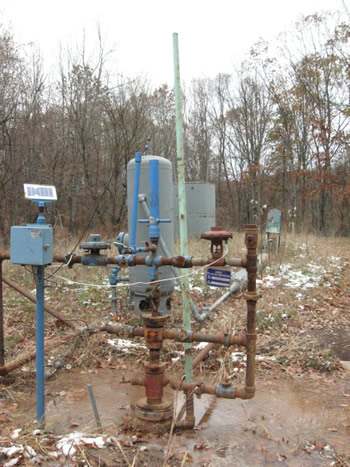
The wellhead "Christmas Tree." The green-blue vent pipe that I've not seen anywhere else comes from below the bolted flange.
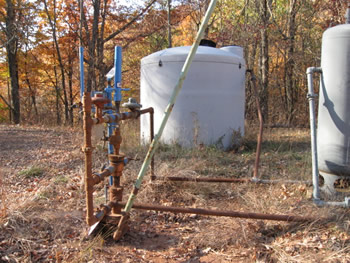
The tank is plastic and holds 2800 gallons. There is no secondary containment dike as required by state regulations.
This photo was taken in early November.
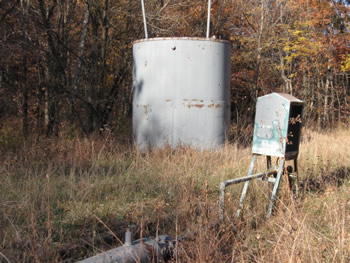
The old 100-barrel tank is still on the site along with other bits of well equipment trash. The operator should haul this stuff off.
This photo was taken in early November.

ATV riders use the bank for thrills. The well site needs a gate or two.
I think this well dates from the 1960s and will know better when I get a chance to check databases.
We'll post more on the constituents of drilling waste.
Posted on Dec. 6th, 2008 at 09:12 pm
Gas Well Site Visits
Examining Well Sites
How We Examined Well Sites
Environmental Assessment
Table with Links to Wells Visited
47-039-05714 Environmental Assessment
47-079-01492 Environmental Assessment
47-039-02026 Environmental Assessment

Gas Well Study is the examination of natural gas wells in West Virginia.
Underground Injection Control Class 2 Wells
These wells are used either for the disposal of oil and gas liquid waste or for the enhanced recovery of oil or natural gas.
Gas Well Study Site Visits
Annual reports, environmental assessments, and individual well information.
YouTube Videos
Select videos from the Gas Well Study YouTube channel.
What Happened at Fernow
An investigation into what caused the vegetation death in the land application area after landspraying hydraulic fracture flowback waste.
The Spill at Buckeye Creek
An investigation into a spill from a Marcellus well site into Buckeye Creek in Doddridge county.
The Details
Plunger Lift Technology on Gas Wells
Fluids Brought to the Surface during Production
Plugging a Well
How To Read a Lab Report
Information the Completion Report Provides
Casing and Cementing