Environmental Assessment -- Chloride Testing
The chloride test strips come from Hach (www.hach.com -- search for chloride test strip) and what we use are the low range test strips (30 mg/l to 650 mg/l). The strips have a scale on them with an orange strip in the center that goes nearly to the top. The orange strip turns white in response to chlorides and all you have to do is read from the scale how high the change occurs to get the concentration.
We do water tests two ways -- either by getting a sample in a container or by clipping the test strip onto a wood shim (from Lowes or some other builders' supply) and sticking the shim in the mud so that the bottom of the test strip is in the water but not touching mud.
It's important when testing a sample that the whole test strip not be immersed. When the test is completed a black line appears. That part of the test strip needs to be kept dry. We use binder clips to help hold the test strip on a shim or on a container.
Soil tests are a little more complex. We use plastic Ball freezer containers from the grocery store -- small ones for soil samples (purple lids) and larger ones for testing (green lids). At home we dump the soil sample from the purple lid container into the larger container and mix with an equal amount of distilled water (also from the grocery store). The mixture is shaken for 30 seconds and then let sit. Some samples settle fairly quickly, some take a day or more. The test strip can't be set in mud or silt or the crud will clog the titrator. We use a clip to hold the test strip at the right level.
It can take a while for a test using a test strip -- a few minutes to what seems like an hour. Generally if there are high chlorides the test is faster. The only issue with the test strips is that they must be stored at 86 degrees or less. For summertime we're putting just a few in a pill bottle and keeping that in an insulated bag when we're out at a site.
Counting shipping and test strip, a test costs about $1.40. Chlorides are great for us since there are criteria for waste management and water quality (both domestic and rivers and such) in West Virginia. We figure if a soil test is over 30 mg/l then there is probably contamination.
The photographs shown below are from the sampling for the Environmental Assessment for 47-079-00731 and 47-079-01492.
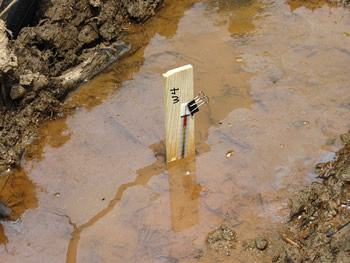
A chloride test strip held to a wood shim by a binder clip. The shim is standing in a large puddle. A sample number is written with a Sharpie on the shim.
What looks like an oily sheen on the puddle is a type of bacteria.
This is sample W4, >650 mg/l.
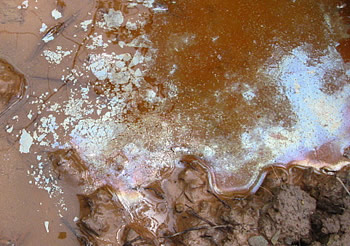
When tapped with a stick, the bacteria's sheen breaks up into blocks like this.
This type of bacteria is attracted to water with high iron. High levels of iron are found in brine and oil and gas well waste.
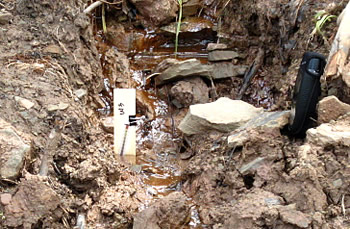
This wood shim with a test strip is in a small stream.
This is sample W3, >650 mg/l.
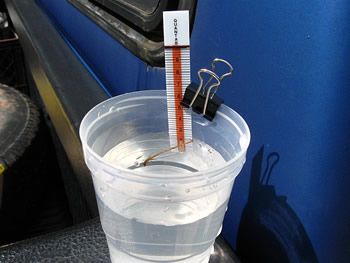
We collected a sample of water going into a culvert and used a binder clip to hold the test strip to the cup. The thick black line on the test strip shows that the test is done.
This is sample W5 and the result was 57 mg/l.
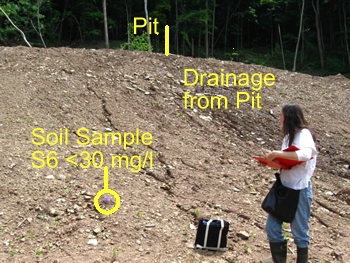
Soil samples are collected and recorded. Testing is at home after mixing with distilled water.
This is the fill slope showing drainage from the pit above and to the right of Molly. Soil sample S6 (<30 mg/l) is on the fill slope and away from visible drainage signs.
Sources
Otton, James K. and Zielinski, Robert A. 2000. Simple techniques for assessing impacts of oil and gas operations on Federal Lands: a field evaluation at Big South Fork National River and Recreation Area, Scott County, Tennessee (online edition). Denver, CO: U.S. Department of the Interior, U.S. Geological Survey, Open-File Report 00-499.
Gas Well Site Visits
Examining Well Sites
How We Examined Well Sites
Environmental Assessment
Table with Links to Wells Visited
47-039-05714 Environmental Assessment
47-079-01492 Environmental Assessment
47-039-02026 Environmental Assessment

Gas Well Study is the examination of natural gas wells in West Virginia.
Underground Injection Control Class 2 Wells
These wells are used either for the disposal of oil and gas liquid waste or for the enhanced recovery of oil or natural gas.
Gas Well Study Site Visits
Annual reports, environmental assessments, and individual well information.
YouTube Videos
Select videos from the Gas Well Study YouTube channel.
What Happened at Fernow
An investigation into what caused the vegetation death in the land application area after landspraying hydraulic fracture flowback waste.
The Spill at Buckeye Creek
An investigation into a spill from a Marcellus well site into Buckeye Creek in Doddridge county.
The Details
Plunger Lift Technology on Gas Wells
Fluids Brought to the Surface during Production
Plugging a Well
How To Read a Lab Report
Information the Completion Report Provides
Casing and Cementing