
Chainsaw Repair
I use several Husqvarna chainsaws to cut firewood. I have a smaller, lighter saw that I like to use for cutting tree limbs and such when preparing a fallen tree log before cutting bolts from the trunk for splitting. My primary saw has been a Husqvarna 445 which has an 18 inch bar. I cut the bolts from logs for splitting with this saw. Last spring when I was near the end of the firewood cutting season the 445 wasn’t operating properly. The engine raced, no matter how I adjusted the carburetor. There was no idle where the chain wasn’t moving, the saw ran full speed all the time. A saw running like that is dangerous and will eventually overheat and become not repairable.
I put the saw aside and used the lighter saw which is still robust enough to take an 18 inch bar if necessary. I intended to try to repair the 445 that summer but always seemed too busy. The fall firewood season arrived and I needed a bigger saw so bought a used Husqvarna 450 that needed a little work. The 450 has a slightly larger engine than the 445 and cuts with more power.
I eventually got to working the 445 in early December. The racing engine was caused by the engine getting too much air which seems crazy but it’s a two cycle engine that operates a little differently than a four cycle engine which would race because it’s getting too much gas. I needed to find the air leak. Generally for chainsaws the air leak is at a crankshaft seal, but not always.
I needed to pressurize the cylinder and crankcase with the carburetor and muffler ports blocked off. I had to create tools to help me do this. To block off the carburetor and muffler ports I cut scrap pieces of thin sheet silicone.
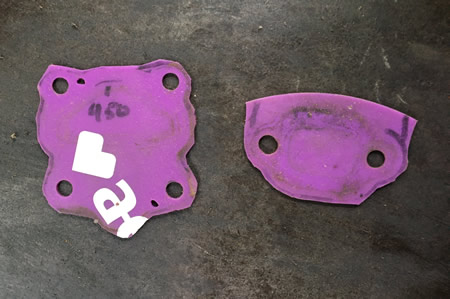
The piece of sheet silicone on the left is used to block the carburetor port and the piece on the right blocks the muffler port. I also needed to create a way to inject air pressure into the cylinder.
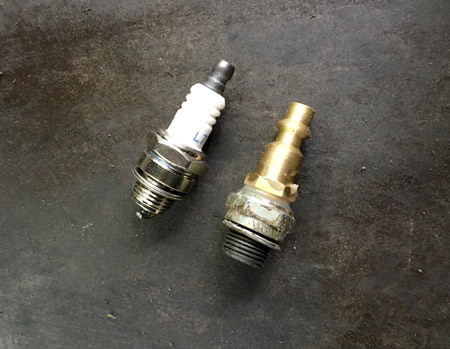
I took a spark plug like the one on the left, broke out the porcelain and electrode and glued in a brass male pneumatic fitting. I used a polyurethane two part glue that dried quickly and was great at filling gaps between the spark plug element and the fitting.
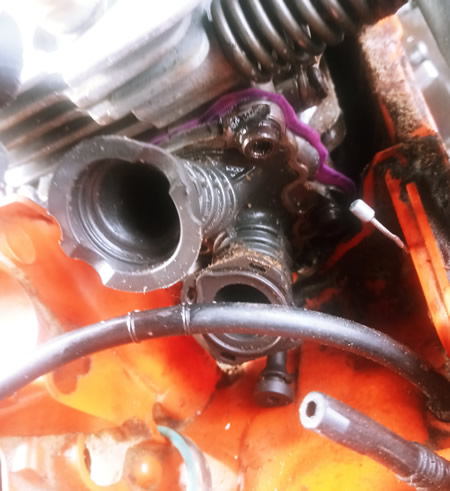
This photo shows the purple silicone piece blocking the carburetor port, held in place by the rubber carburetor boot. The hoses in front are the fuel line and fuel return. The designers of chainsaws cram a whole lot of things in a small space. The Husqvarna 445 and 450 chainsaws have a carburetor which fits on the smaller boot opening, below the larger turbo charger opening which allows more air in for increased speed and power at maximum throttle.
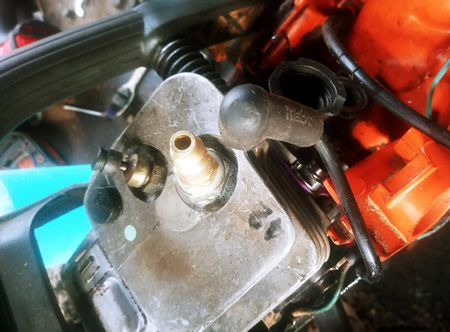
The altered spark plug is installed and everything is ready to inject air pressure. The button fitting next to the spark plug is for making the cord easier to pull when first starting the saw. This was one of the potential sources of the air leak. I used a Mityvac pressure hand pump with gauge to pressurize the cylinder.
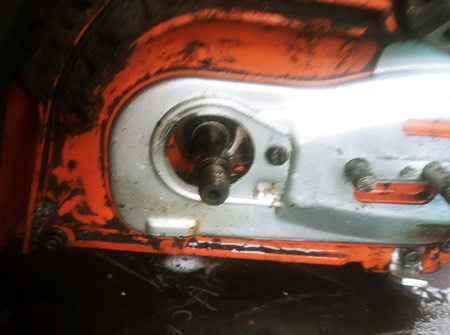
I pressurized the cylinder and sprayed soapy water to find the air leak. It turned out to be the crankshaft seal at the side of the saw where the drive sprocket is, the commonest area for an air leak. At least I knew where the leak was. Some chain saws are designed to so the seal can be easily removed from the outside. For this saw, however, the leaking seal is held in place by the metal cylinder and plastic frame. I had to remove the cylinder to replace the seals.
I didn’t take photos of the repair which was a lengthy and messy job. Once the whole saw was taken apart replacing the seals took just a few seconds. Chainsaws accumulate a lot of oily wood dust. A lot of time was spent cleaning parts with rags, brushes, and mineral spirits.
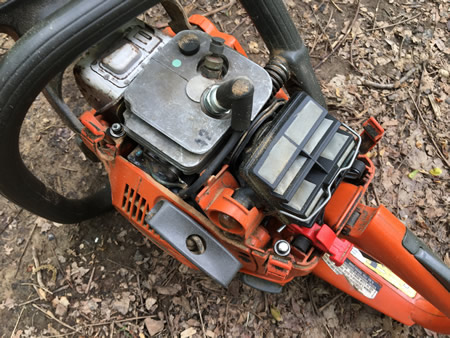
The saw works great now and is safe to operate. This shows the top cover off. The muffler, cylinder top, and air cleaner are visible.
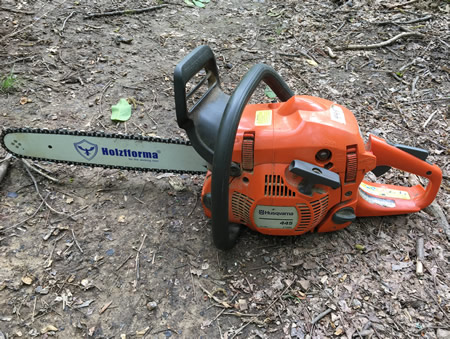
I currently use a 16 inch bar on the saw and have an 18 bar on the Husqvarna 450. It was great being able to use the 445 again to cut firewood this season.