Gas Well Study Updates

I’ve fallen behind in our updates so I’ll combine everything into one post.

First off, there’s a great article from the New York Timesthat we highly recommend: “The Fracturing of Pennsylvania” by Eliza Griswold. The article appeared in last Sunday’s Magazine. It’s about the problems some people who have leased their minerals have experienced with Range Resources in southwest Pennsylvania. The health issues are similar to those we’ve heard about occurring in this state and elsewhere. The company’s run-around is also typical.

We’ve posted a couple of new videos on YouTube (www.youtube.com/GasWellStudy).The most recent is You Get Used To It. We include more of our recorded interview with Paul Phillips (a Kanawha county resident) in this video and for that alone we believe it’s worth watching.

In September we presented our comments to the state for the proposed new regulationcovering horizontal natural gas wells. We’re disappointed with what the Department of Environmental Protection has come up with. What’s happening in this state is that while members of the legislature are attempting to create new regulations for oil and gas, industry and the political establishment (e.g., the governor) are blocking it. What we’re getting instead are regulations written (more or less, more than less) by industry that do nothing to protect the health and safety of the state’s citizens or the environment. Our comments have the state’s proposed regulation appended.

We’ve created a document called ThirtyWells that tabulates the problems we’ve seen in our area with regulatory compliance and environmental issues such as contaminated drinking water supplies. Industry’s awful compliance record in our area is nothing unusual. It’s sad that it’s these people who get to write their own regulations in this state.

And we’ve written an interim report titled Fracture Gel’s Possible Synergistic Influence for Chloride’s Effects on Vegetation. Last summer we made some trial applications on vegetation of fracture gel we made using kerosene, guar gum and water. Those applications with the gel alone showed no adverse effects. When we added 5000 mg/l chloride the adverse effects were much worse than we’d expect from chloride alone. It’s possible that fracture gel enhances the negative effects of chloride. We’ll be looking at this again next summer. The report discusses the types of organic solvents used in making fracture gel (such as kerosene, diesel, and 2-BE). In West Virginia fracture flowback (including gel) is land applied, except for Marcellus wells.

More soon!

Bobo’s Passing

Bobo passed away quietly early Tuesday morning, October 11th. He was in his spot between us, his head on a pillow. He’s been such an important part of our lives since 2000 that it’s hard to write this, even a month later.

He made it through last winter and even at the end had an amazing spirit. This photo was taken on Sunday when we were out in the “old” garden. We miss him.

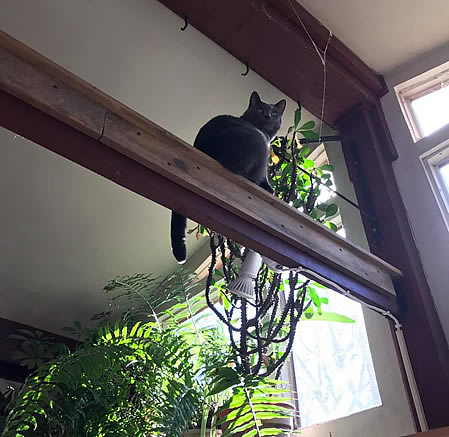
The other cats have reorganized their lives without him relatively painlessly. Little Peach Blossom has discovered a new place to go to in the house. She likes to walk from the loft, on the beams above the kitchen, to either the bookshelf above the sink where Molly keeps some of her cookbooks or to a child’s chair hanging high overhead.

Before we started this version of Sootypaws News it was entirely on our website. You can still see the old pages from years ago. There are lots of photos of Bobo, too.

More soon!

A Visit to the Kanawha State Forest

Last Monday Molly and I took a day trip to the Kanawha State Forest. Molly and her parents had been there years ago but I never had. The Forest is about 8 miles south of Charleston and is beautiful. The CCC set up a camp there (Camp Kanawha) back in 1938 and built trails and buildings in the Forest. We wanted to have a day off, but we also wanted to look at some of the gas wells in the Kanawha State Forest. Just like us, the state, in the case of many of its state parks,owns only the surface. This is true also for the U.S. forest system in this state. Gas companies want to drill in the Monongahela National Forest.

The Kanawha State Forest is noted for its wildflowers. This is cardinal flower which blooms in late summer. We saw them growing along a well road that was in a hollow running next to (sometimes through) a stream. Cardinal flower likes marshy wet places.

At the end of the well road were two gas wells drilled in the 1960s. One of the wells had a sign warning of hydrogen sulfide, a poisonous gas that sometimes comes up with the natural gas.

Molly took this of me while I was making a video record of the site. The second well is visible to the left.

None of the wells we saw had any kind of security, like fencing. That’s surprising because of the inherent dangers at these sites, including an unsecured 20 foot high ladder up a tank at this well site.

We left the well road and walked up out of the hollow on the Beech Glen Trail. Mountain bikes can use this trail going in this direction (up hill). Further ahead we went through a tumble of boulders.

At the top of the ridge we took another trail.

This is a well drilled only a few years ago. Molly is barely visible standing on the edge of the pad in a bare area. We took samples and there was elevated chloride where Molly is standing.

We noted signs of animal visits to the bare area. These are deep scratches made by wild turkey claws. We also saw deer tracks. While we were at the site we saw a group of three finches pecking the dirt in this area, the first time we’ve seen finches do this, though it’s been that members of the finch family like salt.

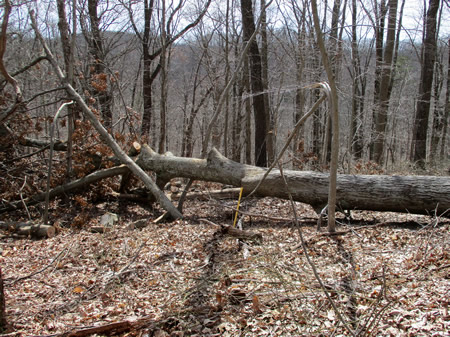
After seeing our last well we took the Wildcat Ridge Trail back to the car. This is another trail used by mountain bikes.The tree lying across the trail is close to 2 feet in diameter. A ramp has been constructed for cyclists to get their bikes over. Cyclists who really like a thrill probably speed up one side of the ramp and down the other. Since it was a quiet day in the park we didn’t get to see anyone do this.

More soon!